Learn More: Static-Dissipative PVC Plating
Static-Dissipative PVC Plating
Available in 3mm, 4mm, 6mm, 10mm. Transparent, colorless, standard sheet size of 4' x 8' (1219 mm x 2438 mm)—other sizes are available on a custom basis. Both surfaces of the sheet are covered with masking paper for protection during shipping, and one or more sheets are packed per carton and then in a wooden crate.
PVDF (polyvinylidene fluoride): Flame-Retardant (FM Listed)

- Revolutionary Static-Dissipative PVC Plating renders acrylic-made products obsolete for any static- or particle-sensitive application
- Chemically embedded dissipative layers maintain a surface resistivity of about 107 ohms/square, even under real-world abuse
- Ideal for cleanroom use—effective static dissipation helps control particulate contamination by eliminating static attraction
- Transparent material allows complete visibility
- Also resists a wide range of corrosive chemicals and will not outgas
This revolutionary material offers a new alternative to standard methods of static control in the cleanroom, lab, and other industrial environments. Like acrylic, it can be easily worked and offers great visibility, yet it also resists a wide range of chemicals (see chart). It is completely noncontaminating, and so can be safely used in the cleanest work environments.
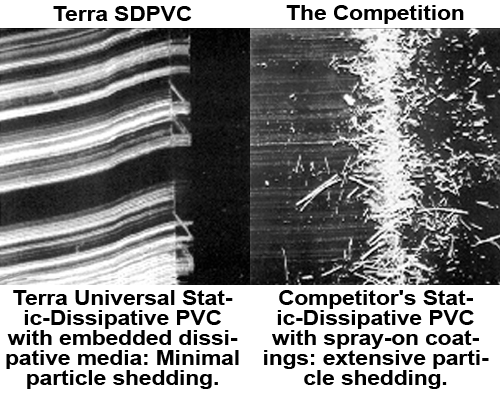
The solvent of the static-dissipative dielectric coating melts the plating and mixes with the coating material so that the mixture adheres to the plate top. Both materials are mingled in the coating process. The coated material has great adhesion power and never comes off. The electrical characteristics are not affected by rubbing, and the transparency remains unchanged for long periods with little or no fogging.
Characteristics
Static-dissipative PVC features surface resistance between 106 and 108 ohms/square—much less than that of other treated plastics. Tests show that when 10KV is applied to the surface, electrostatic potential remains less than 15V, and static decay time is less than 1 second. And because this plating offers such effective static dissipation, it will not attract dust or other contaminating particles that could damage sensitive microelectronic components.
In a test conducted in accordance with ASTM D 257, both colorless and colored transparent plating sheets were subjected to a relative humidity of 20-80% at 10°C to 30°C and the samples exhibited almost no change in physical characteristics. The surface resistivity remained greater than 107 ohms/square.
This plating is also durable. It features superb resistance to UV radiation; tests have indicated almost no loss of static protection after 500 hours of continuous exposure to a fadeometer. In temperature tests, it maintained its dissipative properties after 50 cycles of temperature fluctuations from -20°C to 60°C. It is also completely noncombustible.
It also offers all of the chemical-resistance of standard PVC plating. It remains unaffected by a wide range of chemical solutions (see chart). In the case of mixed chemicals, resistance can vary widely depending on the exact mix. Be sure to perform a test prior to using any new chemical solutions or mixtures.
Applications
This plating allows easy cutting, bending, welding, and adhesive joining, and is therefore ideal in many situations for which no suitable material currently exists. Just consider these possible applications:
- In integrated circuit containers: Static-Dissipative PVC Plating can be used in:
- Desiccator
- Glove Boxes
- Silicon wafer boats
- IC storage containers
- Transparent trays
- IC chips and IC card boxes (PE, PET)
- Universal Hoods
- Transparent magazine rails
- In the cleanroom: Static-Dissipative PVC Plating can be used in:
- Cleanroom partitions
- Cleanroom benches
- Equipment covers
- Chamber inspection windows
- Door and wall linings
- Curtains
- Fluorescent lamp louvers
- Pass-through and tunnel coating
The Razor Scrape Test
Electrical Properties
| Characteristic | Unit | Transparent Static-Dissipative PVC | Rigid PVC Plate | Testing Method |
|---|---|---|---|---|
| Surface Resistivity | omega/ | 106 ~ 10 | 1016 | ASTM D-257/JIS K 6911 |
| Volume Resistivity | omega•cm | 1017 ~ 18 | 1018 | ASTM D-257/JIS K 7194 |
| Saturated Charge Voltage | V | Less than 10 | 3,000 | * |
| Half Life | — | Momentary | Long | * |
- * Measured with a static-honest meter (20°C, 60% RH)
- Applied voltage: 10,000V
- Applied voltage • material distance: 20mm
- Detected voltage • material distance: 15mm
Chemical Resistance
| Chemicals | Time Immersed | Appearance after 3 Days | Appearance after 30 Days | Anti-Static properties after 3 Days | Anti-Static properties after 30 Days | |
|---|---|---|---|---|---|---|
| Acids and Alkalines | Hydrochloric acid | 36% | U | U (Redish) | U | U |
| 20% | U | U | U | U | ||
| Sulfuric acid | 97% | CS (Blackish) | x (Black) | U | U | |
| 60% | U | U | U | U | ||
| Nitric acid | 60% | U | U (Greenish) | U | CS | |
| 40% | U | U | U | U | ||
| Phosphoric acid | 85% | U | U | U | U | |
| Acetic acid | 95% | U | U | U | U | |
| Fluoric acid | 46% | CS (Light Green) | CS (Greenish) | U | x | |
| 10% | U | U | U | U | ||
| Hydrogen peroxide | 10% | U | CS (Powdering) | U | U | |
| Sodium hydroxide | 50% | U | U | U | U | |
| Ammonia aquenous solution | 25% | U | U | U | U | |
| Organic Solvents | Methanol | 100% | U | U | U | U |
| Ethanol | 100% | U | U | U | U | |
| Isopropanol | 100% | U | U | U | U | |
| Butanol | 100% | U | U | U | U | |
| Ethylene glycol | 100% | U | U | U | U | |
| Gasoline | 100% | U | U | U | U | |
| Kerosene | 100% | U | U | U | U | |
| Benzene | 100% | U | U | U | U | |
| Others | Salt water | 30% | U | U | U | U |
| Ammonium | 50% | U | U | U | U | |
| Potassium | 10% | U | U | U | U | |
| Mild detergent | 10% | U | U | U | U | |
| Water | 100% | U | U | U | U | |
- U = Unaffected
- CS = Changed Slightly
- x = not recommended
- Tests conducted on 3 mil., 6 mil and 10 mil material. Immersion temp. 25°C.
| Property | Unit | Transparent Static-Dissipative PVC | Testing Method | |
|---|---|---|---|---|
| Physical Properties | Specific gravity | — | 1.4 | JIS K 7112 |
| Rockwell | M scale | 76 | JIS K 7202 | |
| R scale | 122 | |||
| Surface hardness | Pencil hardness | H | JIS K 5400 | |
| Mechanical Properties | Tensile yield strength | MPa | 74 | JIS K 7162-1B/50 |
| Flexural strength | MPa | 98 | JIS K 7171 | |
| Flexural modulus | MPa | 3400 | JIS K 7171 | |
| Charpy impact strength | KJ/m2 | 2.3 | JIS K 711-1ePA | |
| Thermal Properties | Deflection temperature | °C/1.8MPa | 65 | JIS K 7191 |
| Coefficient of thermal expansion | 10-5/°C | 7 | JIS K 7197 | |
| Thermal conductivity | W/m • K | 0.18 | Laser Flash Method | |
| Specific heat | J/g • K | 1.11 | — | |
| Flammability | — | Self extinguishing | JIS K 6911 | |
| Water absorption | % | 0.02 | JIS K 7209 | |
Abrasion Resistance
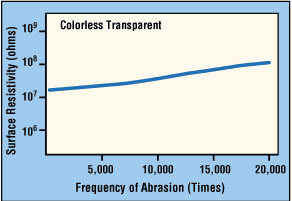
The effect of surface abrasion is very small and produces almost no change in the material’s antistatic characteristics.
- Testing conditions: Scrubbing with nylon fabric at a load of 500 grams
- Testing method: ASTM D 257 (20°C 60% RH)
Temperature and Humidity Effects
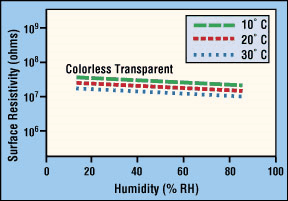
Even when temperature or humidity vary, this material’s antistatic properties exhibit almost no change, and this excellent feature is stable over the long term.
- Testing method: ASTM D 257
