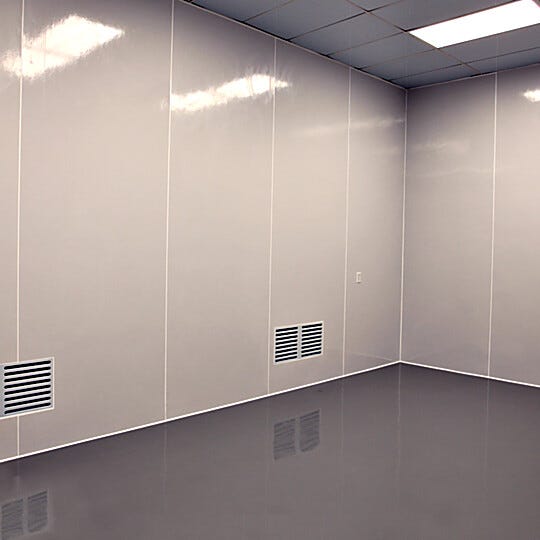
- Available Certified ISO Grade Designs: ISO 7, ISO 8
- Door interlock system reduces cross-contamination; ensures specific doors never open simultaneously
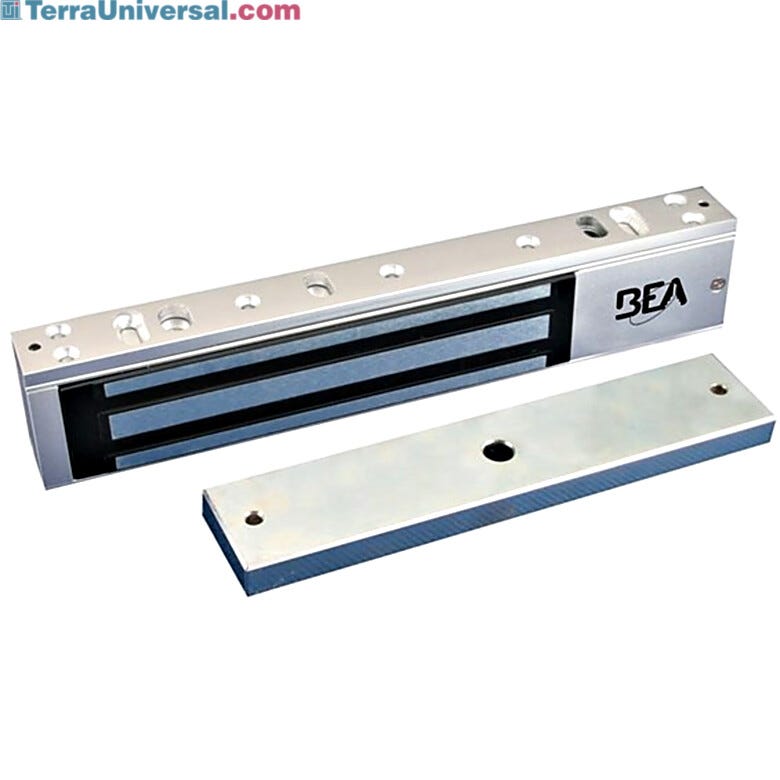
- Low voltage maglock assembly connects to main interlock control module
- Mounts above door and engages when a dependent door opens
- 1 required per single-door assembly
- 600lb holding force
- Talk to an Expert +1 (714) 578-6100
Door Accessories,Cleanroom Accessories & Components,Cleanroom Accessories & Components,Cleanroom Accessories & Components,Cleanroom Accessories & Components,Cleanroom Accessories & Components,Cleanroom Accessories & Components,Cleanroom Accessories & Components,Cleanroom Accessories & Components,Cleanroom Accessories & Components,Cleanroom Accessories & Components,Cleanroom Accessories & Components,Cleanroom Accessories & Components,Cleanroom Accessories & Components,Cleanroom Accessories & Components,Cleanroom Accessories & Components,Cleanroom Accessories & Components,Cleanroom Accessories & Components,Cleanroom Accessories & Components
Single Swing Door Maglock Assembly; for Electromagnetic Door Interlock System
Read more




Similar Products
-
 Group of 14 productsPre-Hung Frameless Manual Swing Doors, Stainless Steel Jambs FromAs low as $1,049Some ship in 10 - 15 days
Frequently Used Together
-
 Group of 24 productsCleanroom Windows Group of 2 productsPass Throughs Group of 345 productsFan/Filter Units
Door Accessories
- Cleanroom Automatic Door
 Short video of the automatic door Cleanroom Automatic Door Terra Universal automatic door shown in a short video
Features and Benefits
Learn More: Vertical vs Horizontal Laminar FlowPrint Copy CopiedVertical vs. Horizontal Laminar Flow Hoods: A Scorecard for Specifiers
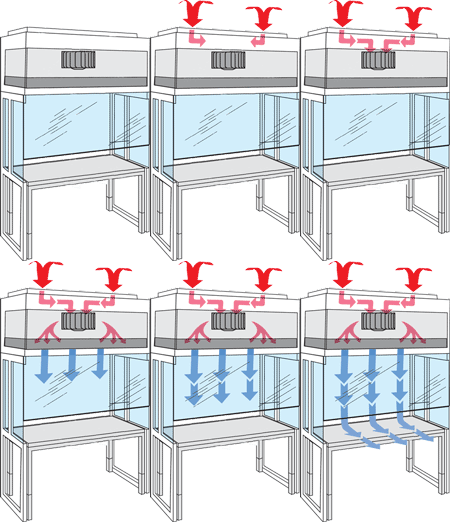
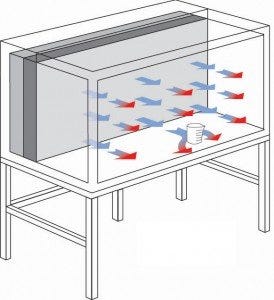
Laminar is derived from the Latin lamina, a thin sheet of material. When used to describe a laboratory hood, the term "laminar flow" refers to air exiting a filter in parallel layers that move at the same speed and in the same direction, vertically or horizontally across the enclosure. Any particles introduced in a laminar flow of air during a work process are predictably swept in the direction of the flow and removed from the enclosure, downstream of critical processes.
Disruption to laminarity results in turbulence, a randomized flow that suspends particles in eddies rather than removing them. Because they can remain in the system, carried by "second-pass" air that swirls around the critical work area, contaminants are deposited unpredictably, often with disastrous results.
Consideration #1: Footprint
Vertical laminar flow (VLF) hoods position the fan filter unit on top of the hood, a space-efficient design that accommodates most facilities as long as overhead clearance isn’t a problem. Horizontal laminar flow (HLF) hoods position the fan on the back of the hood, necessitating as much as 18" or more additional floor or bench space for fan, filter and make-up air flow. In a cleanroom or lab where space is at a premium, that difference alone could determine your choice. Footprint Advantage: VLF Hood
Consideration #2: Air Sash
VLF hoods often have an adjustable sash at the front of the hood to maintain the downward laminar air flow. HLF hoods are generally open at the front of the hood to ensure unrestricted horizontal air flow. The larger opening of an HLF hood makes placement of large objects and instruments easier when compared to a VLF hood although, without a sash to serve as a shield, chemical fumes or powders inside the work area may blow into the operator's face. Sash Advantage: VLF Hood (operator safety); HLF Hood (transferring large materials)
Consideration #3: Laminar Flow
Although both hoods are effective at sweeping particles from the hood, air eventually encounters obstacles that disrupt laminar flow. In most VLF hoods, the work surface creates turbulence, so critical processes must be performed above the surface to avoid contact with "second-pass" air that could contaminate a sensitive operation. Some VLF designs include a perforated floor with sub-surface plenum to reduce this obstruction, but these measures add cost. HLF hoods generally minimize this airflow disruption. However, large objects placed on the work surface can cause swirling or contaminate downstream materials, so critical operations should take place adjacent to the filter face. Laminar Flow Advantage: HLF Hood
We end with a tie; your working conditions will help you determine which of these advantages matter most in your operation.
Safety Alert: Under no circumstances should laminar flow hoods be used in the presence of hazardous materials. Use a fume hood or biological safety cabinet for safe biohazard containment.
Model Horizontal Laminar Flow (HLF) Station Vertical Laminar Flow (VLF) Station ValuLine™ VLF Station ValuLine Whisperflow Hood Portable CleanBooth Flow Horizontal Vertical Vertical Vertical Vertical Nominal Widths 7', 6', 4'
(2.1 m, 1.8 m, 1.2 m)8', 6', 5', 4'
(2.4 m, 1.8 m, 1.5 m, 1.2 m)8', 6', 5', 4'
(2.4 m, 1.8 m, 1.5 m, 1.2 m )6', 5 ', 4', 3 ', 2 '
(1.8 m, 1.5 m, 1.2 m, .9 m, .6 m)6', 4'
(1.8 m, 1.2 m)Nominal Overall Depth and Height 44"D x 63"H
(1118 mm x 1600 mm)41"D x 90"H
(1041 mm x 2286 mm)41"D x 90"H
(1041 mm x 2286 mm)24”/30”D x 41”H
(610/762 mm x 2286 mm)30"D x 82"H
(762 mm x 2083 mm)Nominal Working Space 30"D x 28"H
(762 mm x 711 mm)27"D (686 mm); height depends on workbench used 27"D (686 mm); height depends on workbench used 24”/30”D x 23”H (610/762 mm x 584 mm) 24"D (610 mm); height depends on workbench used Construction Material / Options - Powder coated steel frame exterior
- 304 Stainless steel interior
- Powder coated steel
- 304 stainless steel
- Acrylic or SD PVC shield options
- Powder coated steel
- 304 stainless steel
- Acrylic or SD PVC shield options
- 304 stainless steel frame
- 304 SS, acrylic or SD PVC panels
Powder Coated Steel Frame Work Surface Options - Stainless steel work area
- Optional electropolished finish.
Workbench sold separately; many top materials available. 2-piece frame isolates fan vibration. 304 Stainless Steel work surface included Placed on user-furnished bench (stands available) Workbench sold separately; many top materials available. 2-piece frame isolates fan vibration. Blower Type Integrated Fan/Filter Unit Integrated Fan/Filter Unit Integrated Fan/Filter Unit Integrated Fan/Filter Unit Integrated Fan/Filter Unit Air Flow, 7' (2.1 m)
6' (1.8 m)
4' (1.2 m)8' (2.4 m)
6' (1.8 m)
5' (1.5 m)
4' (1.2 m)8' (2.4 m)
6' (1.8 m)
5' (1.5 m)
4' (1.2 m)6'(1.8 m)
5'(1.5 m)
4' (1.2 m)
3 ' (.9 m)6' (1.8 m)
4' (1.2 m)CFM (m³/hr) 1130 (1920)
960 (1632)
650 (1104)1300 (2209)
960 (1632)
840 (1427)
650 (1104)1300 (2209)
960 (1631)
840 (1427)
650 (1104)960 (1632)
840 (1427)
650 (1104)
558 (948)960 (1632)
650 (1104)Filter Types HEPA or ULPA HEPA or ULPA HEPA or ULPA HEPA or ULPA HEPA or ULPA Prefilter Washable Polyurethane Foam Washable polyurethane Foam Washable polyurethane Foam Washable polyurethane Foam Washable polyurethane Foam Portability / Installation Access Not portable Not portable.
Wider than standard door frameNot portable.
Wider than standard door framePortable Portable: CleanBooth frame uses casters. Front Sash Configuration Options Take-up air slots and plenums on three sides of the work area - Motorized sliding shield (allows simplified disassembly and transport)
- Strip shield curtains
- Or no shield
- Counterweighted sliding shield (disassembly requires technical capabilities)
- Strip shield curtains
- Or no shield
Tilt-Up Uses softwall panel kits: vinyl, anti-static vinyl, or
non-outgassing polyurethaneLighting LED LED LED LED Optional fluorescent lighting Noise Level, Measured 30" (762mm) from filter face at 90 FPM (.46m/s) <50 dBA <50 dBA <50 dBA <50 dBA <50 dBA Airflow Monitor Options Minihelic gauge monitors backpressure across filter Includes touch screen controls with backpressure indicator Optional: air velocity meter and differential pressure gauge for filter backpressure Optional swing-vane anemometer Optional: air velocity meter and differential pressure gauge for filter backpressure Power Requirements 120 VAC, 50/60 Hz
or 220VAC, 50 Hz110 VAC, 50/60 Hz
or 220VAC, 50 Hz110 VAC, 50/60 Hz
or 220VAC, 50 Hz110 VAC, 50/60 Hz
or 220VAC, 50 Hz120 VAC, 50/60 Hz
or 220VAC, 50 HzPrice Range $9,300 – $14,300+ $6,000 - $14,000+ $5,000 - $10,000+ $1500 $2,000 - $4,500+ Application Synopsis - Large working space
- Airflow design reduces turbullence
- Quiet, reliable fan/filter modules
- Differential pressure gauge monitors filters
- Clean, easy-to-sterilize internal surfaces
- Large working space and overhead clearance
- Economical
- Quiet, reliable fan/filter modules
- Optional counterweighted shield requires overhead clearance for disassembly
- Large working space and overhead clearance
- Economical
- Quiet, reliable fan/filter modules
- Optional counterweighted shield requires overhead clearance for disassembly
- Portable
- Economical, variety of panel materials
- Quiet, reliable fan/filter modules
- Easy cleaning
- Large working space and overhead clearance
- Economical
- Quiet, reliable fan/filter modules
- Portability
Products Tailored to Your Cleanroom Environment
Provide Terra with your desired ISO Grade design. We will tailor the product to meet your criteria and certify it with a report appended to your invoice. Certificate includes all the necessary information to streamline audits and facility compliance. Continuous Product Improvement
At Terra, we strive to develop and produce the highest quality products for our customers to improve health, safety, performance, and yields. Our product quality is enabled by high-grade manufacturing equipment and processes, 50 years of engineering and application expertise, and our commitment to continuously improve.Similar Products-
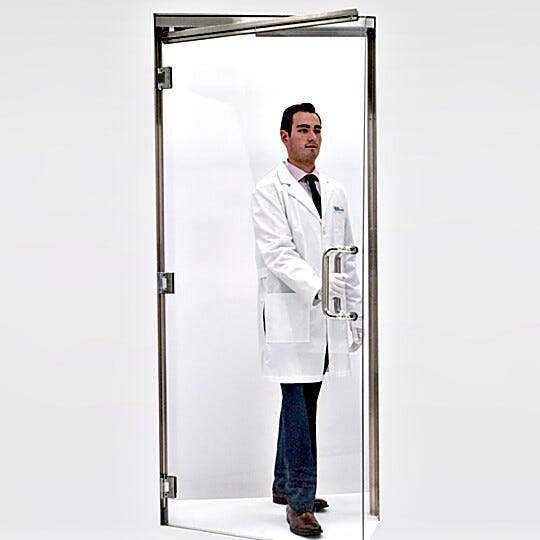 Group of 14 productsPre-Hung Frameless Manual Swing Doors, Stainless Steel Jambs FromAs low as $1,049Some ship in 10 - 15 days
Frequently Used Together- Group of 24 productsCleanroom Windows Group of 2 productsPass Throughs Group of 345 productsFan/Filter Units
On a tight schedule? Choose FasTrak 24/7 Priority Service to help meet your critical schedule for Terra-manufactured products, either before or after your order is placed.*
- FasTrak 24/7 provides a 24/7 commitment to meet the shipping date YOU specify, regardless of quoted lead times.
- FasTrak 24/7 assigns a dedicated production team plus a dedicated senior expeditor working three shifts to meet your delivery specification.
- FasTrak 24/7 guarantees* to meet the agreed-to specified ship date.
Call for pricing. FasTrak service fees cover costs of additional services only, without additional profit.
* Terra's FasTrak services limited guarantee: to ship on the ESD or date specified OR to refund up to 100% of FasTrak charges. This guarantee covers no direct, special, consequential or other damages and is strictly limited to up to 100% of the amount paid for FasTrak service. When a specified ship date is missed due to factors outside Terra's control (vendor performance, deliveries by shipping companies, etc.) and random factors such as accidents, the credit of up to 100% of the FasTrak 24/7 may not apply. FasTrak service requested after order placement will be quoted and accepted based on available time remaining before required ship date.